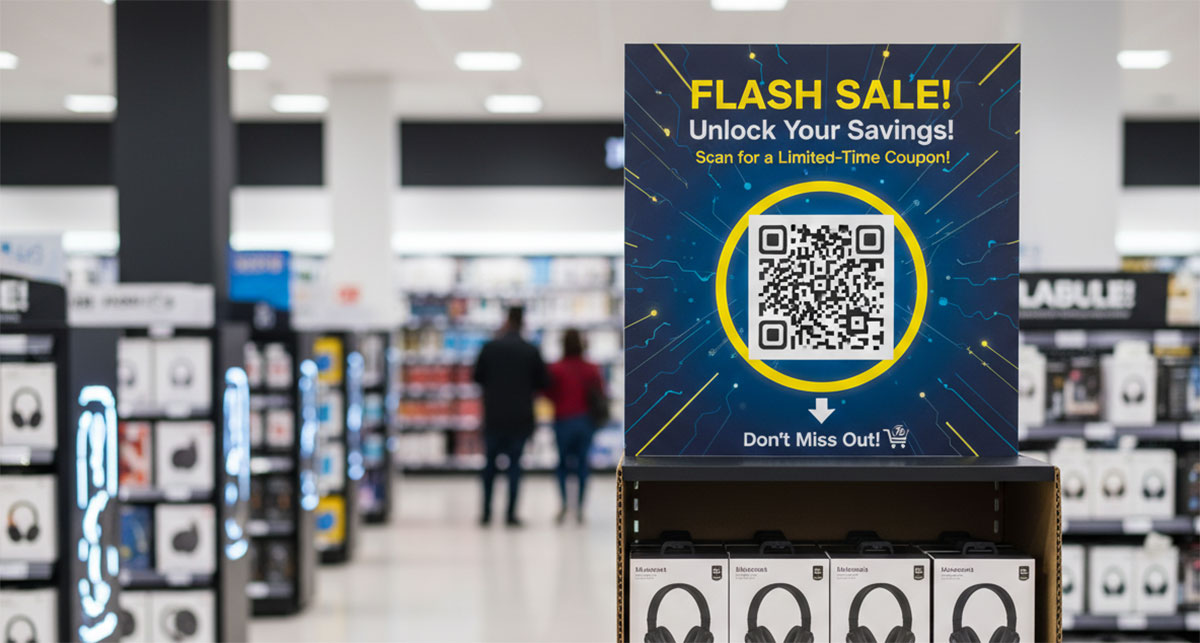
The retail landscape has changed forever. The modern customer journey is no longer linear; shoppers don’t just shop “offline” or “online.” They do both simultaneously. They browse your physical aisles while checking reviews on their smartphones, a behavior known as showrooming. Yet, shockingly, many brick-and-mortar stores still treat their physical shops and their e-commerce websites as two entirely separate worlds.
Think about your current promotions. When you hand out paper discount coupons at the cash register, what happens? They get stuffed into wallets, thrown into the bottom of handbags, and ultimately forgotten or expired. Worse, you completely lose the ability to track which promotions actually worked, and you miss a golden opportunity to capture valuable customer data for future retargeting.
It’s time to unify your sales channels, close the attribution loop, and track your true ROI with Dynamic Coupon and Promo QR Codes.
Seamlessly Connecting the Aisle to the Digital Cart
By integrating a beautifully customized, dynamic QR code onto shopping bags, receipt paper, storefront windows, or Point-of-Sale (POS) displays, you give customers an immediate, interactive reason to engage with your brand digitally.
Here is how smart retail managers and marketers are using QR codes to boost sales, capture data, and build loyalty:
1. The “Scan for Discount” Strategy: Frictionless Conversions
The biggest enemy of e-commerce is friction. Asking a customer to remember and manually type a promo code like SUMMER24X! on their mobile phone often leads to abandoned carts.
Instead of handing out a passive flyer, display a bold QR code that says: “Scan for 15% off your next online order.” When scanned, the QR code routes them directly to a landing page where the discount is automatically applied to their digital cart. This seamless transition capitalizes on the impulse-buying mindset. It’s also the perfect solution for out-of-stock items: if a customer can’t find their size in-store, one scan lets them buy it instantly online with a discount, saving the sale you would have otherwise lost.
2. Build Your Email List: Turn Foot Traffic into Digital Leads
Anonymous foot traffic is a missed opportunity. If a customer walks in, buys a t-shirt, and leaves, you have no way to contact them again.
Use a QR code to “gate” your best promotions. When the customer scans the code on a store display, they are taken to a sleek pop-up asking for their email address or phone number to unlock the coupon. A 10% discount is an incredibly cheap price to pay to acquire a lifelong marketing channel. You have just transformed a one-time, anonymous walk-in shopper into a targeted CRM lead that you can retarget for years to come.
3. Create Urgency & Scarcity: Agile Marketing with Zero Printing Costs
Retail marketing requires agility, but printing new physical posters and cardboard displays for every single campaign is slow, expensive, and terrible for the environment.
Because these QR codes are dynamic, the printed code never has to change, but the destination link can be updated instantly from your dashboard. You can use retail psychology to drive sales by running flash campaigns on the exact same physical display: point the QR code to a “48-Hour Weekend Flash Sale” on Friday, switch it to a “Cyber Monday Clearance” next week, and a “Valentine’s Day Gift Guide” in February. Your physical store becomes as flexible and dynamic as your website.
4. Flawless ROI Tracking: Closing the “Dark Traffic” Loop
Historically, physical retail advertising has suffered from the “dark traffic” problem: it’s incredibly hard to prove if a window display actually drove sales.
By adding UTM parameters (tracking tags) to the URL within your dynamic QR code, you solve this problem instantly. You will be able to look at your Google Analytics and see exactly how much web traffic—and how many actual dollars in online sales—were generated by that specific cardboard cutout near the cash register versus the sticker on your shopping bag. You can finally A/B test physical store placements and prove the ROI of your offline marketing.
Ready to bridge the gap between offline and online sales?
Stop wasting your marketing budget on untrackable paper coupons that end up in the trash.
With QRcdr.pro, you can generate highly customized, beautifully branded dynamic QR codes for all your retail promotions. Update campaigns on the fly without reprinting, track exactly where and when your codes are scanned, and seamlessly drive your physical shoppers directly to your e-commerce checkout. Turn your physical store into your most powerful digital marketing asset today.